Terrés Family
by Melville Sahyun and Teresa Newton Terrés

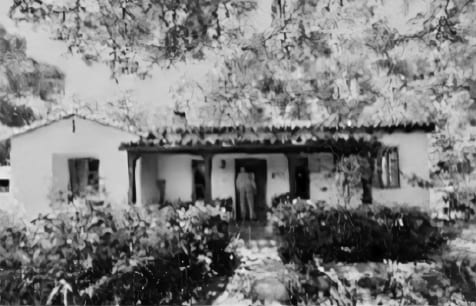
Terrés home on Cathedral Oaks
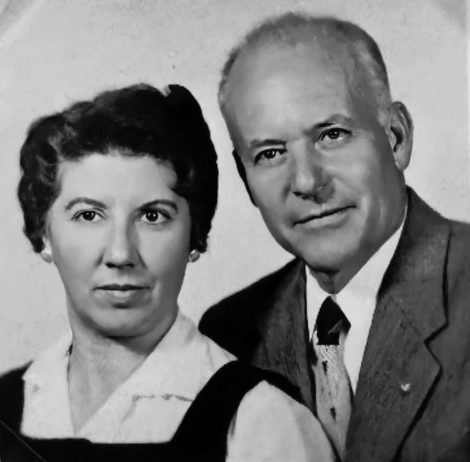
Diego and Marie Terrés, 1950 (Courtesy of Teresa Newton Terrés)

Diego Santos Terrés, Sr.
The Man who Built a Town
Diego Santos Terrés, Sr. (1898–1965) was born in Linares, Spain, and came to California from Hawai’i where he and the rest of his family had been indentured laborers on a sugar plantation. Though his formal education was left incomplete by this turn of events, he became a respected builder in Goleta, California. Diego transformed empty lots into homes and businesses, developing his signature style: Spanish Moderno. This is the same architectural style adopted by architect Robert Ingle Hoyt for the Sahyun Laboratories building, now the Sahyun Library of Santa Barbara County Genealogical Society. After the 1925 Santa Barbara earthquake, civic leaders had chosen Spanish Colonial Revival as the city’s architectural identity—red tile roofs, white stucco walls, courtyards, and wrought iron details. Diego helped bring this vision to life, blending Old World charm with postwar innovations like off-street parking and open layouts.
By 1930, he had built a home as a wedding gift for his bride-to-be, María Trinidad Fernandez (1909-1973) whose family had also immigrated from Spain via Hawai’i, and thence to San Francisco before María Trinidad’s birth there. They came from Spain on the first ship to Hawai’i, S.S. Heliopolis, which sailed from Málaga in 1907. Diego and María Trinidad were married later in 1930 in Old Mission Santa Barbara. Years later, to save the home from demolition during the construction of Highway 101 at the Turnpike exit, the home was disassembled and reassembled on a quiet corner off Cathedral Oaks Road—a testament to his craftsmanship and devotion.

Old Town Goleta structures, built by Diego Terrés. Drawing by Teresa Newton Terrés. (Courtesy of Teresa Newton Terrés)
Diego also helped reshape Goleta’s Hollister Avenue. He refurbished buildings in the 5700 block, expanded housing for his growing family, and constructed the Goleta Post Office—now Domingo’s Café. His design featured modern flow and customer-friendly touches like rear parking. As a civic leader of the Goleta Chamber of Commerce, Diego signed the town’s first sewer lease—laying the groundwork for future growth.
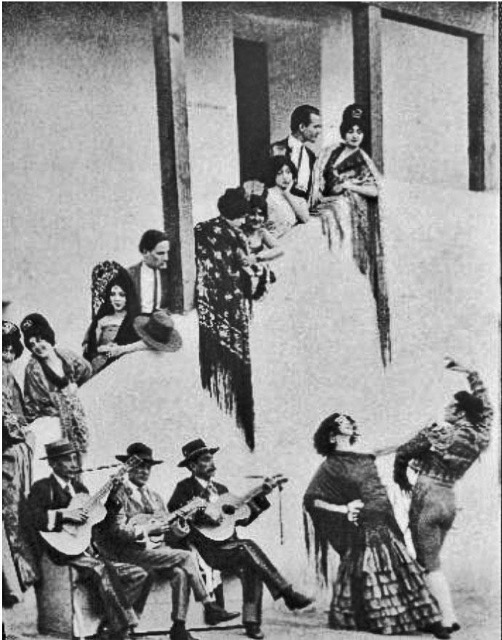
Throughout his life, Diego balanced construction work with a love of performance and travel. One of the most iconic images of Santa Barbara’s Old Spanish Days Fiesta—used in the 1926 brochure and again for the 1989 poster—features Diego as the central musician among three seated men. He was also part of the dance group who traveled to San Francisco in 1925 to represent Santa Barbara in California’s Diamond Jubilee celebration, as described in the Winter 2024 issue of Ancestors West. Later, he was a founding member of the Poole-Verhelle Dance Group, which evolved from garden parties to become Las Noches de Ronda, the beloved courthouse dance programs during Old Spanish Days Fiesta. In later years, Diego and María had a signature dance: Sombrero Blanco, a traditional dance of Old California.
Diego passed away at 67, resting at the home of his nephew Geronimo Terrés Jr., in San Mateo, CA, after attending a family wedding.

1926 Fiesta Poster (Photo by J. Walter Collinge)
Geronimo Angel Terrés, Jr.
War Hero and Pioneering Immunologist

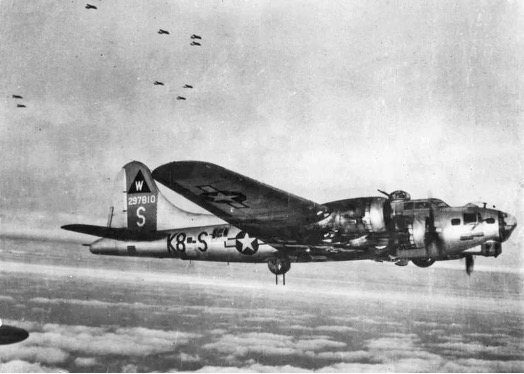
B-17G bomber 298710S, the plane in which Geronimo Terrés flew on his last mission (Courtesy of 398th Bomb Group Memorial Association)
Geronimo Angel “Jerry” Terrés, Jr. (1925-2016), Francisca’s grandson, was born during the 1925 Santa Barbara earthquake. He considered his life ordinary until World War II intervened. Even before graduating from Santa Barbara High School, Geronimo was drafted into the US Army Air Corps and was assigned to the crew of a B-17G bomber in the 398th Bomb Group. He was a waist gunner, the most dangerous position on the plane, in the plexiglass “bubble” suspended below the middle of the fuselage. In early 1945, his crew flew from the U.S. to England. On March 9, during a mission over Kassel, Germany their bomber (tail number 297810 S) was shot down near Pilsen, Germany. All but one of the crew survived. However, they were captured, interrogated, and imprisoned before enduring a brutal POW march to a prison camp in Moosburg, Germany.
On May 1, 1945, General Patton’s 4th Army liberated the camp, and Patton himself came to visit. In his diary, Patton noted: “Visited a prison camp of some 30,000 Allied prisoners… considerable cheering, clapping and picture taking.”
After the war, Geronimo returned home. By 1959 he had earned a Ph.D. from Stanford University and become a pioneering immunologist. He worked at Brookhaven National Lab, Stanford, and Tufts University where he taught in the medical school. His career included a sabbatical year in Switzerland, which gave him the opportunity to revisit the places he had seen under very different circumstances during his war experience.
In retirement, he returned to Palo Alto and turned to genealogy. In 2001, Geronimo and his wife, Helen, traveled to Spain, the birthplace of his father and grandfather, Diego Antonio Terrés Figueredo (1859-1909). There, they traced the Terrés family lineage and began documenting the family’s migration from Spain to Hawaii to California. His privately published family history, Tomo I and Tomo II, provides much of the information contained in this exhibit. Geronimo’s work was all done, of course, before the days of online genealogical research, perhaps all to the better. Online Spanish genealogical research is complicated by the design of most genealogical search engines, which search on the basis of an ancestor’s ”last” name. In the Hispanic naming tradition, the ultimate surname is the family name of one’s mother or spouse; one’s own patrilineal family name is the penultimate surname.

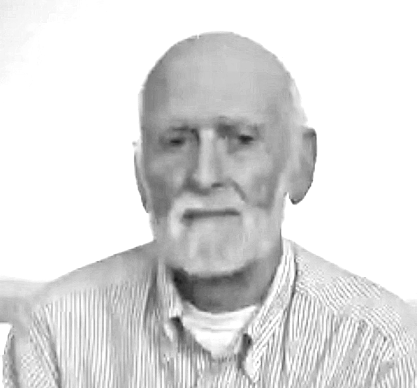
Geronimo Terrés, Jr., Ph.D. in 2013 (Courtesy of 398th Bomb Group Memorial Association)