
Violet Ray
by Jim Campos
In 1928, Violet Ray anti-knock gasoline was introduced by 3,500 dealerships into the Pacific Coast States from San Diego to Canada. Carpinteria had one of the dealerships, under the proprietorship of Federico Gonzalez, at the intersection of 7th Street and the Coast Highway (Carpinteria Avenue).
Violet Ray gasoline was unique. Its name was derived from Violet Ray technology, popular at the time, and espoused by the sleeping clairvoyant, Edgar Cayce, who was a sensation of the era for his healing remedies. Note that the Violet Ray Gas Station sign has a futuristic look to it. The pumps had a clear top so the gas color would stand out. Ads for Violet Ray claimed that the pure violet color would change if it encountered an inferior grade of gasoline. How’s that for keeping customers coming back for more?!
Violet Ray Gasoline Stations were advertised as full-service stations, that is, check the oil, wash the windows, and check the air pressure in the tires. Mr. Gonzalez’s operation also had a mini-mart, and several cabins behind it–an auto court–for traveling motorists. The auto court had a mysterious, eerie quality, hidden from view. The circumference was covered by tall, thick, green shrubs that formed a triangle. The way in was through an aperture in the back, off Reynolds Ave. (Yes, that Reynolds Avenue, which has its own exit on the southbound U. S. 101 Freeway!–could it be the shortest avenue anywhere in the world?)
Violet Ray, gasoline, and Mr. Gonzalez disappeared quickly from the scene, but left a legacy. The minimart could have been the first Mexican-owned market in Carpinteria. Very little is known about him, but he almost certainly was a relative of the huge Gonzales clan that would follow into the community. The Mexican barrio from 5th Street to the Coast Highway, South to North, and Linden Avenue West to the top of 7th Street, proliferated with Gonzales family members. There were also the families of Lopez, Medel, Molina, Raya, Sanchez, and Saragoza, large families all, but none as numerous as the Gonzales family. As for the gasoline station, minimart, and motel at the top of 7th street, it was directly across the newly constructed Aliso School, the school for Mexican children, until integration, thanks to the Westminster case in Orange County, was required according to California state law in 1947. The children attending Aliso School loved buying their candy, soda, baseball cards, kites, etc. from the various proprietors who followed Mr. Gonzales for decades.
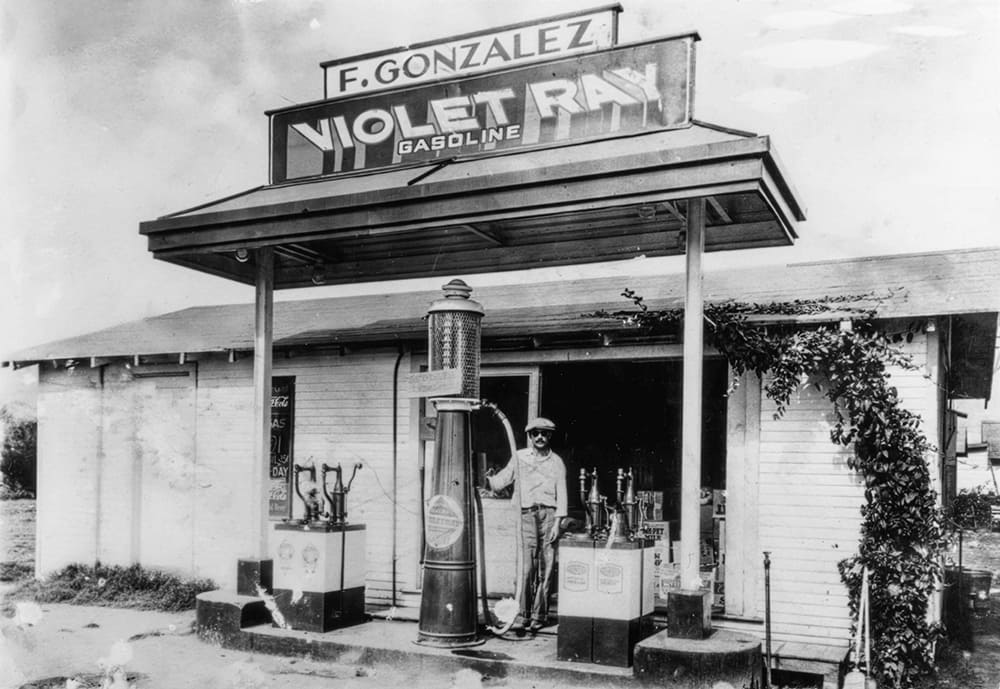
(Photo courtesy of the Carpinteria Valley Museum of History)