Ontiveros Family
Tomás P. Ontiveros (1866 - 1959)
Californio Vaquero
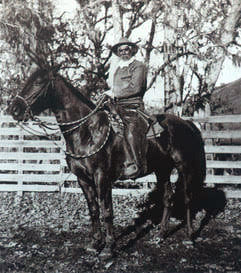
Tomás Ontiveros, Rancho Alisal, circa 1930 (Courtesy of Charles Perkins)
Tomás P. Ontiveros lived his life in true “Ontiveros Rancho” style, embracing cattle ranching, skilled horsemanship, cultural traditions, community, celebrations, religion, honor, and a deep familiarity with the manners and gentility of the Spanish gentleman. He lived his life as a Californio Vaquero.
Tomás “Tom” was born on February 19, 1866, in San Gabriel, California, the first son of Patricio and Maria Leonor “Eleanora” (Serrano) Ontiveros. His paternal grandfather, Juan Pacifico Ontiveros, was born on September 24, 1795, in El Pueblo de la Reina de Los Angeles. In 1837, Juan Pacifico received a Spanish land grant for the rancho called San Juan Cajón de Santa Ana. This covered 35,970.92 acres in Orange and Los Angeles Counties and was approved by Governor Juan B. Alvarado; this was given to Juan Pacifico to protect the interests of the Mexican government. The family lived on this land until moving to Rancho Tepusquet in the Santa Maria Valley in 1856, though Patricio, Tomás’s father, and two of Patricio’s siblings remained at Rancho San Juan Cajón de Santa Ana. Juan Pacifico purchased Rancho Tepusquet from Matthew Biggs and Domingo Dávila. He was the third settler to arrive in the Sisquoc Valley, after Benjamin Foxen and Tomás Olivera.
It has been noted that Tomás stated he came to the Santa Maria Valley when he was six years old, roughly 1870. He stayed there until moving to the Santa Ynez Valley in 1890. On October 31, 1896, he married Paulina Gonzales of Santa Ynez at Zaca Ranch; Rev. F.M. Lack officiated the ceremony. The ceremony was described as “an outdoor ceremony performed under a big oak tree with Father Lack of Old Mission Santa Ines riding out to the ranch by horse and buggy to officiate.” Santa Barbara New Press, March 13, 1952.
Together, Tomás and Paulina had five children: Adolpho Ontiveros (1899-1982), Leonora Ontiveros (1902-?), Lawrence Ontiveros (1903-1977), Cleotilla “Tilla” Ontiveros (1909-?), and Solina Ontiveros (died at an early age).
In 1897, Tomás, along with his brothers, founded and operated a ranch in the Happy Canyon district of the Santa Ynez Valley. From 1905 until his retirement in 1943, Tomás also worked as a cowboy on San Marcos Rancho, San Julian Rancho, Jalama Rancho, and the Mahoney and Alisal Ranches. He also rode as a special guest on many Los Rancheros Visitadores rides.
The true essence of Tomás Ontiveros is clearly shown in the following passages from the book San Ramon Chapel Pioneers and Their California Heritage by Erlinda Pertusi Ontivero and many newspaper articles.
(Tom) has that charm of manner which marks the Spanish gentleman. He was born in California in the Los Angeles area in 1867 [1866] and comes from a very distinguished family…Tom Ontiveros has lived for the greater part of his life in the Santa Ynez Valley. In 1896, he married a member of a pioneer family in the valley, Paula Gonzales. His wife has been dead for some years.
Tom was a rider and rode the ranges since a lad. He rode the San Marcos and Alisal cattle ranges in the days of the Texas longhorns, when the ranches were unfenced, and the cattle kept within bounds by the riders. During the long years, he has noted many changes. [One of his early feats was the capture of a wild steer that frequented the Loma Alta of the San Marcos Ranch. The horns of this steer, with a ‘spread of 46 inches,’ are still in possession of the family.]
As a rider, he had few equals, and now, despite his 86 years, he stands as straight as an arrow. He often rode in Fiesta parades, an example of perfect horsemanship. His friends laugh about the time he refused the offer of a silver-mounted saddle. Instead, he used his own riding saddle mounted on his range horse. He led the parade of silver-mounted high stepping horses with their riders in full regalia. Tom wore plain clothes with a knotted bandana around his neck and came in for his full share of applause.
– Grace L. Davison, Santa Barbara New Press, February 28, 1953.
Tomás died on May 27, 1959, at the age of 93, at a local rest home (Sunny Corner) in Santa Barbara, after several years of illness. He is buried in the family plot at Calvary Cemetery.
Ontiveros Family Spanish Ancestry
by Lenni Valencia-Hall
To understand more of Tomas Ontiveros, it’s essential to go back to Ávila, Spain, where around 1555, Francisco Ontiveros gathered his family and set out for the New World, specifically to the Spanish territory of Mexico. Nearly two hundred years later, Teodoro Ontiveros was born around 1720 in Rosario, Sinaloa, Mexico. He was the first to bring the Ontiveros family to Alta, California. Teodoro had a son, Josef Antonio Ontiveros, who was born in Pueblo San Pedro de Chametla (in Sinaloa) in 1744. Josef, an early military member under the Spanish regime, participated in the American Revolution with the Rivera Expedition of 1781.
In 1781, Josef Ontiveros became the first member of the Californian Ontiveros family. He arrived in California as a soldier with the second overland expedition of Spanish colonists. Their goal was to settle and claim the Los Angeles area as a Spanish settlement. The full original name of the town was El Pueblo de Nuestra Señora la Reyna de Los Ángeles (The Town of Our Lady, the Queen of the Angels).
Josef’s grandson, Juan Pacifico Ontiveros, eventually became a prominent landowner and rancher. Juan was born on September 24, 1795, in El Pueblo de la Reina de Los Angeles. He was the paternal grandson of Josef Antonio Ontiveros y Niebla and Ana Maria Carrasco y Birviescas, both natives of Chametla, Sinaloa, Mexico. His parents were Juan Patricio (1772-1834) and Maria Antonia (Rodriguez) Ontiveros (1780-1859).
In 1837, Juan Pacifico Ontiveros received the Rancho San Juan Cajón de Santa Ana Mexican Land Grant, which covered 35,970 acres in what is now Anaheim, Placentia, and Fullerton (Orange and Los Angeles Counties).
In 1855, Juan Pacifico bought and settled on Rancho Tepusquet, which covered 8,901 acres in present-day Sisquoc, Garey, and northeastern Los Alamos.
On March 17, 1829, Juan Pacifico and his wife, Maria Martina del Carmen (Osuna) Ontiveros of the Santa Barbara Presidio welcomed their first son, Patricio Ontiveros (1829–1924), on Rancho Santa Gertrudis in Santa Fe Springs, California. In 1856, Patricio and his family moved from Los Angeles County to Rancho Tepusquet in Santa Barbara County. On January 20, 1853, Patricio married Maria Leonor “Eleanora” Serrano, who also came from a long-standing and prominent Spanish family, at the San Juan Capistrano Mission. Patricio dedicated most of his life to Rancho Tepusquet and eventually owned 220 acres, a share of the rancho. He and Maria raised sixteen children. Their eighth child was Tomas Ontiveros.
Tomas spent most of his life in the Sisquoc Tepusquet area of the Santa Maria Valley and the Santa Ynez Valley until his death at 93. He is buried at Calvary Cemetery in Santa Barbara, California.
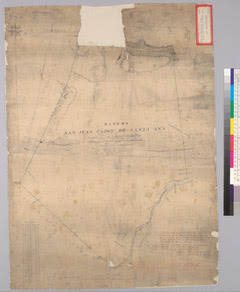
Diseno - Rancho San Juan Cajon de Santa Ana (Courtesy of CALISPHERE University of California, UC Berkeley, Bancroft Library, Maps of private land grant cases of California)
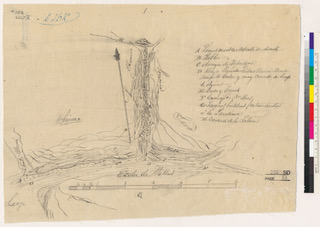
Diseno - Rancho Tepesquet (Courtesy of CALISPHERE University of California, UC Berkeley, Bancroft Library, Maps of private land grant cases of California)