Gilberto “Gil” Garcia (1939- )
Retired Architect and Civic Leader

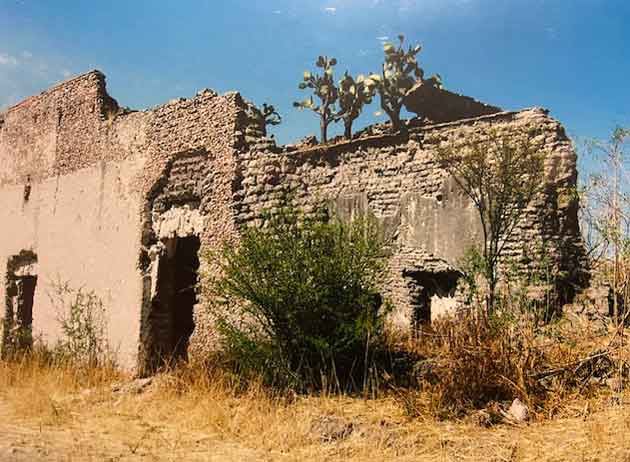
Remains of Hacienda where Bernardo was born and worked on the outskirts of Union de San Antonio in the Highlands of Jalisco. The hacienda was burned down by the Mexican Government Army when they went looking for the owner of the Hacienda who was a leader in the 1926 to 1928 Christian Revolution.
Gil Garcia was born and brought up in Goleta, the second of 8 children born to Bernardo and Carmen (Correa) Garcia. Bernardo`s family migrated from Jalisco, Mexico in 1927 as refugees from the 1926-29 Christero Revolution. Carmen’s family had migrated from Zacatecas earlier in the century as refugees from the Mexican Revolution (1910-24). Both revolutions had disrupted the campesino communities in which they lived and worked. Carmen was born in Arizona shortly after her family crossed the U.S. border.
In the U.S., Bernard’s family worked in California’s migrant farm labor circuit. Bernardo and Carmen met in Soledad where her family was part of the Salinas Valley migrant work force. They married there, later while in Fresno the first son was born and realizing the circuit was not conducive to raising a family they settled in Goleta in 1938 and in 1939 Gil was born. Over the years the family grew to 8 total siblings.
The family lived in a neighborhood infused by the culture and ethos of the campesino life that they had had in Mexico – with the centrality of Catholicism, a commitment to hard work, strong family core values and migrant community ties.

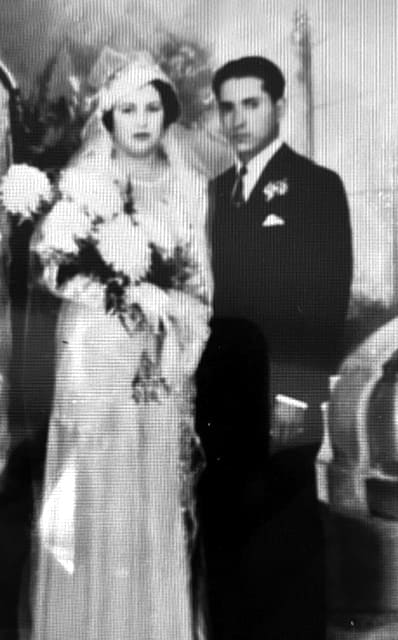
Wedding photo of Bernardo and Carmen Garcia (mid-1930s)
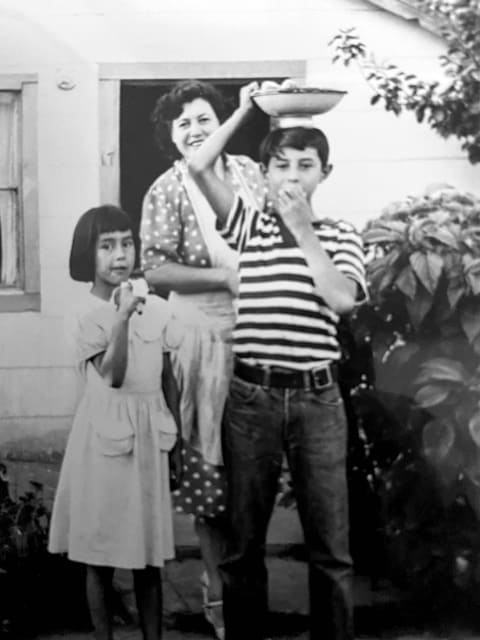
Gil’s mother, Carmen Garcia, with Gil’s younger sister, Gloria, and brother, Ray (undated)
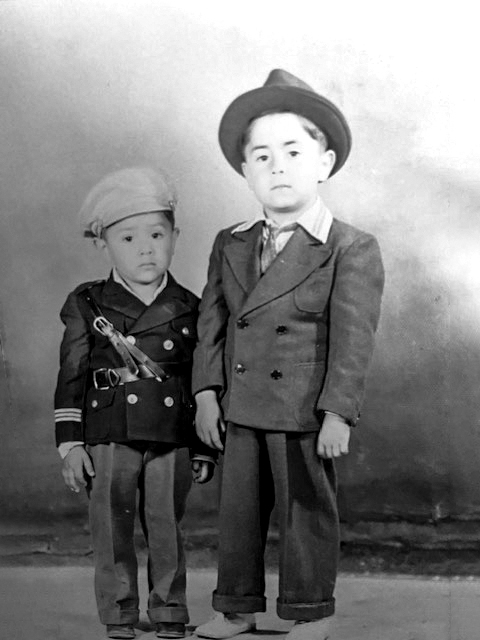
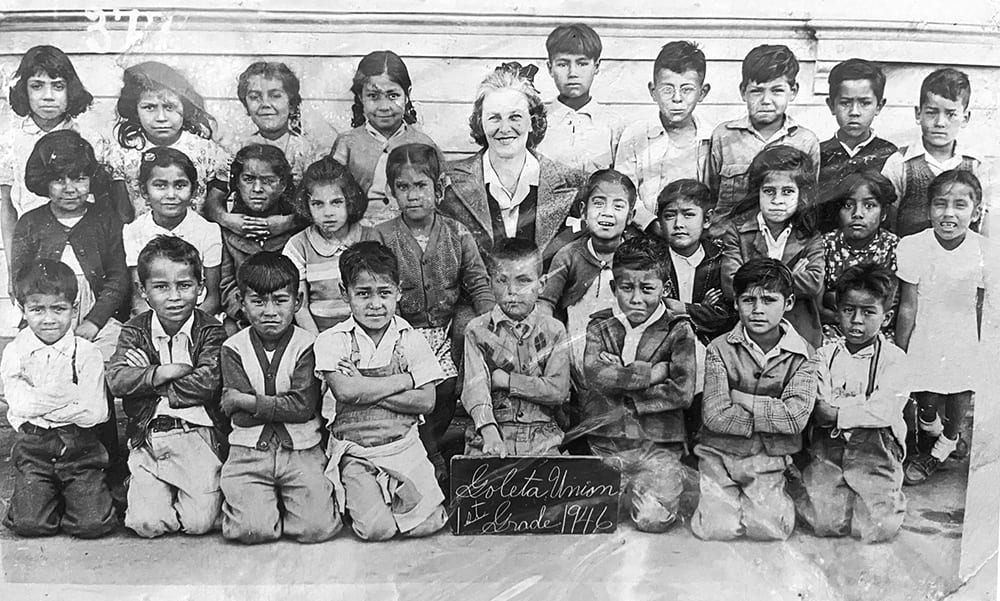
Gil and his siblings attended local schools, and Gil remembers his first immersion in an English-language environment as an experience of culture shock.

Gil Garcia with his first-grade class (1944 or 45)
The three older children worked with their parents and extended families in the fields, where through their elders’ training, especially Bernardo’s, they were schooled in core values of integrity, humility, and generosity that would carry them into adulthood.

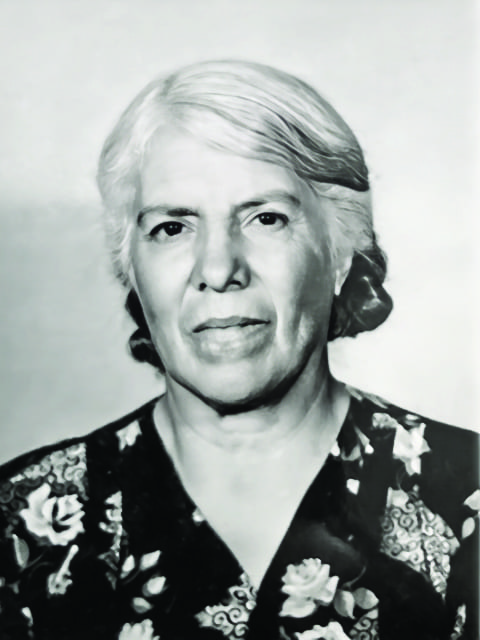
Gil’s maternal grandmother, Mariana Mendoza (undated)
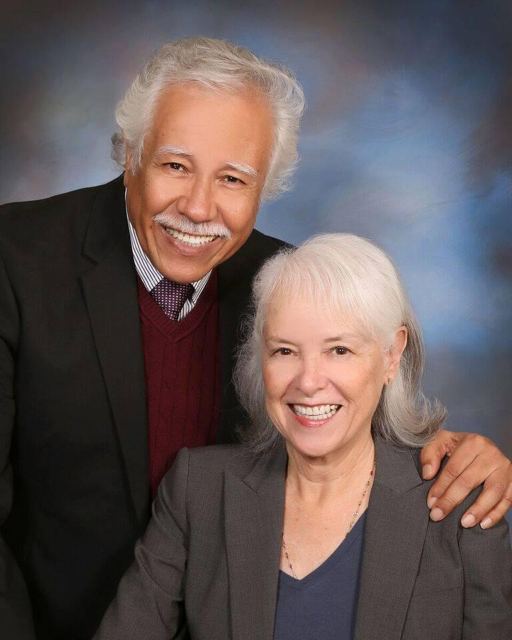
Gil and Marti in 2016 when Marti was President of our Rotary Club. Gil had been president in 1989. They attended the Rotary International conference in Seoul, South Korea both years.
After graduating from Santa Barbara Catholic High (1957) and serving in the US Air Force, Gil returned to Santa Barbara in 1962, where he pursued his interest in mechanical engineering by taking an entry-level position at the architectural firm Arendt Mosher & Grant. Through that work experience, he gained the skills and knowledge to become a licensed architect in 1972 and established his own practice, Garcia Architects, in 1976. His greater fulfillment has been in civic and philanthropic service – arenas in which he has called upon the life lessons and values that he learned through his father’s stories. He served for a decade on Santa Barbara’s City Council and, with wife Marti Correa de Garcia, on numerous non-profits, including the Santa Barbara/Puerto Vallarta Sister City Committee and the Rotary Club of Santa Barbara North. He was long active in Santa Barbara’s Mental Wellness Center, serving as Board Chair in 2000.
Gil’s many contributions to the community were recognized in 1997 with the Santa Barbara Lifetime Achievement Award. Honoring his parents’ Mexican roots, he has been a longtime collector of Mexican prints depicting themes of labor, gender and domesticity in campesino farming life and culture. Sixty pieces of that collection were recently donated to UCSB’s Art, Design and Architecture Museum, where the exhibition was celebrated with a festive opening on September 27, 2025, and serves as a testament to the importance of campesino culture in the linked histories of Mexico and the U.S.

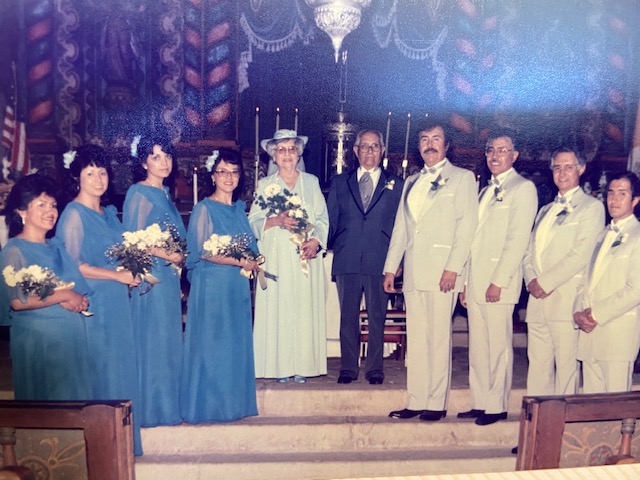
Gil Garcia (third from right), his 3 brothers and 4 sisters, and his parents, Bernardo Sr. and Carmen, at their parents’ 50th wedding anniversary celebration (mid-1980s)
All photos courtesy of Gilbert Garcia.
Sources
Fernandez, Sonia.2008. “Forging Cross-Border Ties, Gil Garcia Reconnects with Roots”
Santa Barbara Noozhawk, March 26, 2008. https://www.noozhawk.com/forging_crossborder_ties_gil_garcia_reconnects_with_roots/ Accessed September 6, 2024.
Garcia, Bernardo Mendoza. 1940 United States Federal Census. Santa Barbara, California. Roll: m-t0627-00334, Page: 3B, Enumeration District: 42-46. Accessed on Ancestry.com. 1940 United States Federal Census [database on-line]. Provo, UT, USA: Ancestry.com Operations, Inc., 2012.
Garcia, Bernardo Mendoza. 1950 United States Federal Census for 1950. Santa Barbara, California. Roll: m-t0627-0033, Page: 3B, Enumeration District: 42-46. Accessed on Ancestry.com. 1940 United States Federal Census [database on-line]. Provo, UT, USA: Ancestry.com Operations, Inc., 2012.
Garcia, Bernardo Mendoza. US WW II Alien Registration. U.S. National Archives and Records Administration; Maryland, USA; Flexoline Index Data File, 1940-1955.
Accessed on Ancestry.com. Lehi, UT, USA: Ancestry.com Operations, Inc., 2025.
Garcia, Gilberto. 2021. Oral History Interview. Robert Ooley, interviewer. Architectural Institute of America – Santa Barbara Chapter (AIASB), Oral History Series. https://www.youtube.com/watch?v=7Dlp8m6uwcE Accessed September 8, 2024.
Garcia, Gilberto. 2024. Interview. Mary Hancock and Mary Jacob, interviewers. September 5, 2024.
Briz, Ana (curator). 2025. Mexican Prints: The Garcia-Correa Collection. Art, Design & Architecture Museum, University of California, Santa Barbara. September 13-December 7, 2025. www.museum.ucsb.edu.